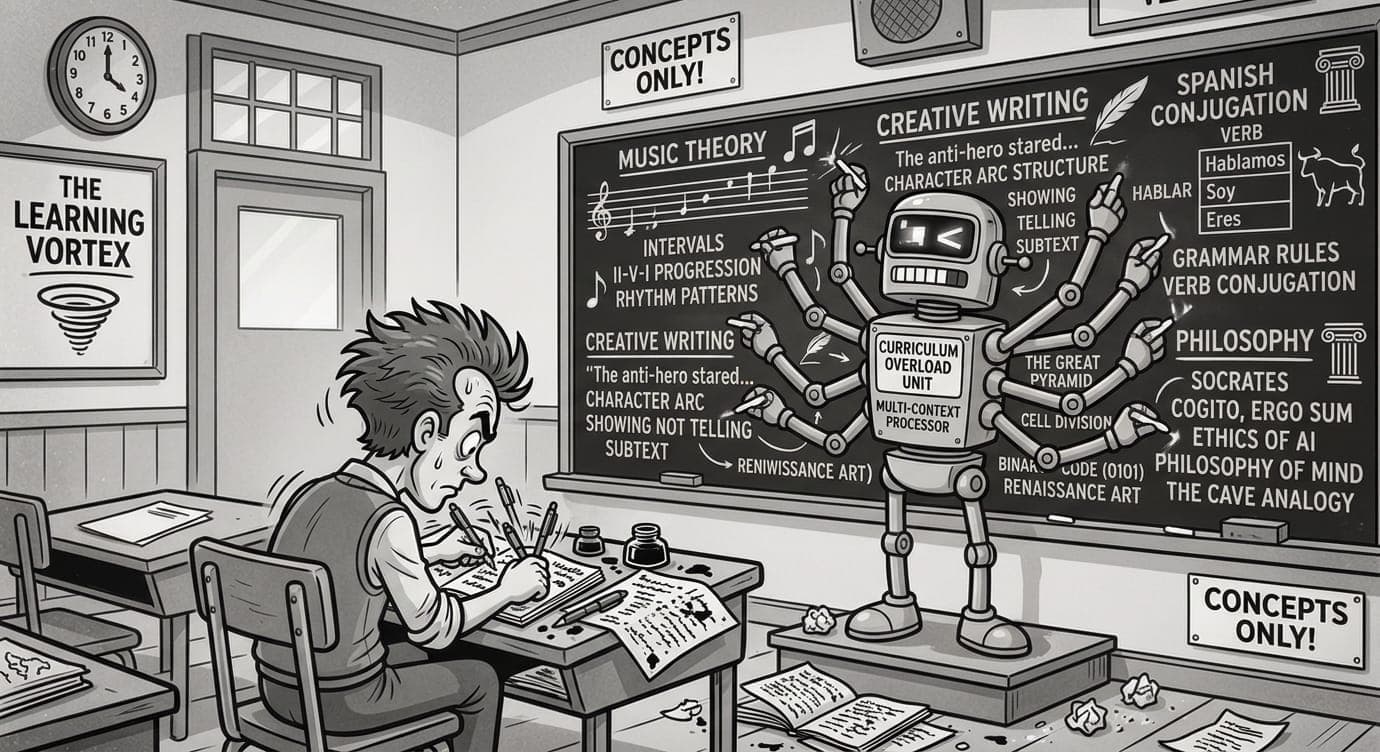
We're in the middle(early stages even) of a massive paradigm shift and people are struggling to keep up.
For many, AI is this nebulous and omnipotent entity that can give you answers to anything and everything you ask it. It can draft powerpoint presentations, vibe code websites, write marketing copy, and in general do your job for you.
Whether you're a college student writing a paper or a salesperson drafting a client proposal, AI can do it better and faster.
But in my mind this is a massive disservice to yourself. AI is a tool, nothing more. And it's an incredibly flexible tool. Yes it can act as a full stack programmer, marketing rep, writer, assistant, etc. But it can also act as a very competent teacher, one with infinite patience that can explain things a million different ways until you understand.
What is the end goal of learning?
I mean this in a very loose sense. The way we were taught in school you need to listen to the lecture, read the book/do the assignment, and pass the test to prove that you've actually learned something. But if you can't recall the underlying lesson or recreate it independently, did you actually learn it?
Many of my colleagues are trying to keep up with AI coding and are talking about doing this course from X programming blogger as a way to stay on top of things. This is a relic of the old paradigm.
As Naval said: “Number of books completed is a vanity metric. As you know more, you leave more books unfinished. Focus on new concepts with predictive power.”
Reading a book to completion is something many of us believe at our core is important, if not completely necessary, in order to be well versed in a given topic. But books are a means to an end, and the end goal is to understand core concepts.
Given that goal, and the fact that we all now have access to AI teachers, why aren't more people using it to further their knowledge? In my mind that's the correct way to use AI: if you're trying to do something you don't know how to do, have AI teach you how to get there, don't just have it do the work for you.
To be clear, this doesn't mean you should still do everything by hand. I don't really write code anymore, Claude does that all for me. My job has moved from that of writing code to that of dev team manager, where all the employees I manage are AI agents.
But vibe coded apps inevitably break. They typically don't scale well, because people without deep technical understanding can't weigh the pros and cons of different tech stacks, infrastructure tradeoffs, idempotency guards, background action queues, and a million other things that go into building good software.
These days I spend most of my working hours planning builds out in the Claude desktop app then firing individual build phases off in Claude CLI. The planning phase easily takes up 80-90%+ of my attention, and I often do it while agents are running in the background writing code. AI is not a panacea, good developer judgement is still required.
And my understanding of deep technical concepts and developer judgement have improved exponentially specifically because I ask AI questions about why we're doing things a certain way, what the pros and cons are of different approaches, and even push back when it seems to be making assumptions that go against what I know to be the desired end goal of the thing I'm building!
Where is human in the loop necessary?
This is one of the most important questions for people to truly sink their teeth into and understand as this wave progresses. AI is very good at some things, and complete shit at others. The line separating them is very murky and constantly moving, so it's more important than ever for people to constantly learn and hone their judgement if they want to remain relevant.
But this isn't just a safeguard against AI-based job displacement: this is a call to action for each and every one of us to be come the Renaissance man/woman we're capable of being! Yes I'm a pretty good programmer, excellent cook, a decent volleyball player, and generally competent at many other things.
But deep down, I've always wanted to be a highly dynamic individual who can play music, write fiction stories, speak multiple languages, and do everything else under the sun. Yes there are time/attention constraints, but previously there were monetary constraints(teachers for these things can get expensive quickly) that may no longer be relevant.
As a teacher AI can understand your current competency level, outline the desired end goal, build a roadmap for you to get there, and have scheduled daily lessons where it teaches you the topic bit-by-bit and asks you questions 1000 different ways until your understanding is complete.
And we all have access to this for $20 a month.
On a recent call a colleague of mine joked that he thinks AI is making humanity dumber as a whole. While I think this may be true in the short term, I try to be an optimist and think it doesn't need to be this way! AI used correctly empowers the individual to learn at an astonishing rate, and it's a disservice to yourself to not use it accordingly.
So ask yourself: where do I want to learn more/grow? Do I need to be constrained by my job title, or can I do more now than I did before? Where am I, where do I want to be(personally or professionally), and how do I get there? You can ask these questions on your own, but AI makes a great brainstorming partner.
Now get out there and learn!